
Last updated on May 24, 2026
Quick Answer:
Self-publishing a book typically costs between $0 and $5,000+, depending on editing costs, cover design pricing, formatting fees, ISBN purchases, and marketing expenses.
Introduction
In the United States alone, an estimated 300 million self-published books are sold annually, generating roughly $1.25 billion in sales — underscoring the massive market authors are investing in and competing within.
Self-publishing a book in 2026 typically costs between $0 and $5,000+, depending on your editing level, cover design quality, formatting choices, ISBN purchase, and marketing budget. On the low end, you can publish on Amazon KDP for $0 upfront if you handle editing, design, and formatting yourself. A realistic mid-range publishing budget for most serious authors falls between $1,500 and $4,000, covering professional editing and a custom cover. A premium production approach with developmental editing, high-end design, and paid marketing can exceed $5,000 to $8,000+.
Amazon Kindle Direct Publishing does not charge an upfront publishing fee, but that does not mean self-publishing is free. The real cost of self publishing comes from professional services that directly impact book quality and sales performance.
If you’re unsure what level of editing your manuscript needs, start with our breakdown of types of editing to understand the difference between developmental editing, line editing, copyediting, and proofreading.
And if you’re evaluating whether professional help fits your publishing budget, review our full guide to editing services explained before committing to a specific editing cost.
In this guide, you’ll see a full breakdown of editing costs, cover design prices, formatting fees, ISBN expenses, marketing budgets, and Amazon KDP royalties—so you can calculate the true cost to self publish a book and plan your publishing budget accurately.
If you’re also comparing professional help, see our overview of editing services and how the process works.
If you’re deciding whether professional editing is worth the price, read should you invest in professional editing.
The Real Cost to Self Publish a Book (Quick Summary Table)
The real cost to self publish a book depends on the quality level you choose and how much of the work you handle yourself. While Amazon KDP does not charge an upfront publishing fee, most authors invest in editing, cover design, formatting, ISBN registration, and marketing to produce a competitive book.
For a full breakdown of what Amazon’s model means for your bottom line, see our detailed guide on the cost of self-publishing a book on Amazon.
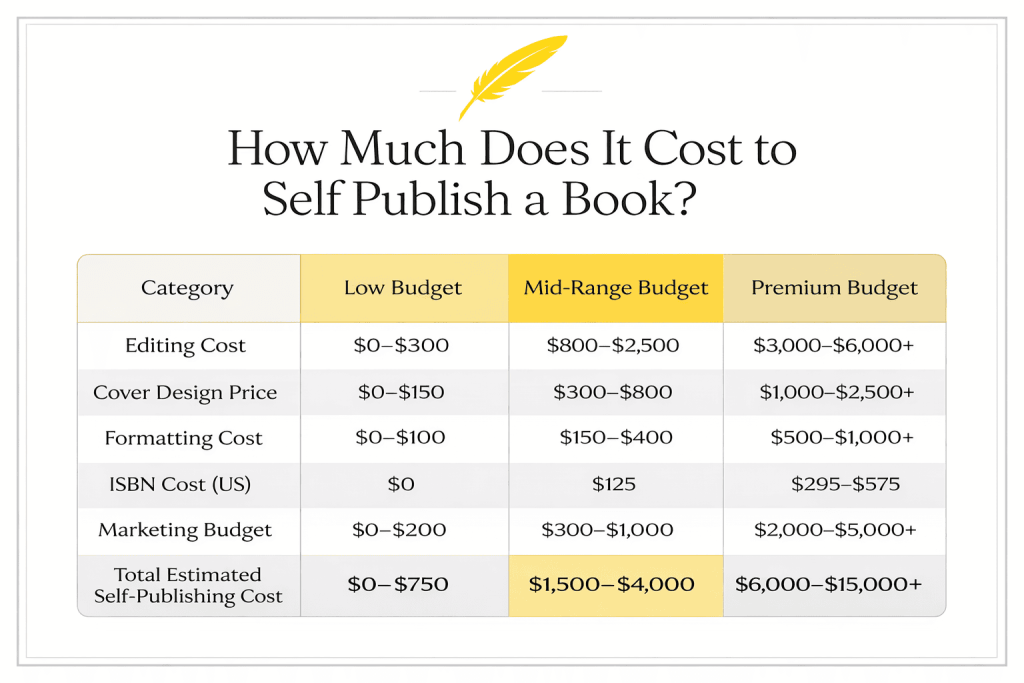
Below is a quick self-publishing cost breakdown to help you estimate your publishing budget.
| Category | Low Budget | Mid-Range Budget | Premium Budget |
|---|---|---|---|
| Editing Cost | $0–$300 (beta readers / light proofread) | $800–$2,500 (professional copyediting) | $3,000–$6,000+ (developmental + line + proofreading) |
| Cover Design Price | $0–$150 (DIY or premade) | $300–$800 (custom professional cover) | $1,000–$2,500+ (custom illustration / series branding) |
| Formatting Cost | $0–$100 (DIY using Word or free tools) | $150–$400 (professional ebook + print formatting) | $500–$1,000+ (complex layouts / special formatting) |
| ISBN Cost (US) | $0 (free KDP ISBN) | $125 (single ISBN via Bowker) | $295–$575 (ISBN bundle purchase) |
| Marketing Budget | $0–$200 (organic launch) | $300–$1,000 (newsletter promos / ARC services) | $2,000–$5,000+ (ads + launch campaigns) |
| Total Estimated Self-Publishing Cost | $0–$750 | $1,500–$4,000 | $6,000–$15,000+ |
Self-Publishing Budget Checklist (2026)
- Editing cost
- Cover design price
- Formatting fee
- ISBN cost
- Marketing budget
- Total cost target
Want the free budget calculator? Join the newsletter.
[newsletter_form]
Next, see the deeper cost breakdowns for Amazon publishing cost, cost to publish a book, and the average cost to publish a book.
As you can see, the total cost to self publish a book can range from almost nothing to well over $10,000 depending on your production standards and marketing strategy. Most serious self-publishing authors budget between $1,500 and $4,000 to ensure professional editing, strong cover design, and proper formatting.
In the next sections, we’ll break down each publishing cost category in detail so you can calculate your exact self-publishing budget with realistic pricing expectations.
Editing Costs (Biggest Variable)
Editing is usually the largest self-publishing cost and the biggest quality differentiator. While Amazon KDP does not charge a publishing fee, professional editing is where most serious authors invest the bulk of their budget. Editing prices vary based on manuscript length, editor experience, and the level of service required.
If you’re unsure what level you need, start with types of editing and what each service includes.
Below is a breakdown of typical editing costs in USD for a 60,000–80,000 word book.
Developmental Editing Cost
Developmental editing focuses on structure, plot, pacing, character development, argument clarity (for nonfiction), and overall manuscript strategy. It is the most intensive and therefore the highest editing cost tier.
Typical pricing range:
$0.03–$0.08 per word
Estimated total for 60,000–80,000 words:
- 60,000 words: $1,800–$4,800
- 70,000 words: $2,100–$5,600
- 80,000 words: $2,400–$6,400
Flat rate examples:
Some professional editors quote $2,000–$6,000+ depending on manuscript complexity and genre.
Developmental editing is a significant publishing investment, but for first-time authors or complex nonfiction projects, it often prevents structural problems that can hurt reviews and long-term sales.
Line Editing Cost
Line editing focuses on style, clarity, tone, and sentence-level flow. This is where your writing is refined for readability and emotional impact.
Typical pricing range:
$0.02–$0.06 per word
Estimated total for 60,000–80,000 words:
- 60,000 words: $1,200–$3,600
- 70,000 words: $1,400–$4,200
- 80,000 words: $1,600–$4,800
Flat rate examples:
Many editors quote $1,500–$4,000 for a standard-length novel.
Line editing costs depend heavily on manuscript condition. A cleaner draft lowers the overall editing price, while heavily revised manuscripts increase the editing budget.
Copyediting Cost
Copyediting addresses grammar, consistency, clarity, and technical correctness. This is the most common editing service self-publishing authors purchase.
Typical pricing range:
$0.015–$0.04 per word
Estimated total for 60,000–80,000 words:
- 60,000 words: $900–$2,400
- 70,000 words: $1,050–$2,800
- 80,000 words: $1,200–$3,200
Flat rate examples:
Professional copyediting for a full-length novel typically costs $1,000–$3,000 depending on manuscript complexity.
Copyediting is often considered the minimum professional editing cost serious authors should budget for before publishing.
Many professional copyeditors follow standards outlined in The Chicago Manual of Style.
Proofreading Cost
Proofreading is the final editing stage completed after formatting. It focuses on catching typos, formatting errors, punctuation mistakes, and minor inconsistencies.
Typical pricing range:
$0.01–$0.02 per word
Estimated total for 60,000–80,000 words:
- 60,000 words: $600–$1,200
- 70,000 words: $700–$1,400
- 80,000 words: $800–$1,600
Flat rate examples:
Many proofreaders charge $700–$1,500 for a standard novel.
Proofreading costs are lower than developmental or line editing, but skipping this step can result in negative reviews and lost credibility.
Total Editing Budget Scenarios
Depending on which editing services you choose, your total editing cost can vary significantly:
- Minimal editing budget: $900–$2,000 (copyediting + proofreading)
- Mid-range professional budget: $2,000–$5,000 (line editing + copyediting + proofreading)
- Full developmental package: $3,000–$8,000+ (developmental + line + copyediting + proofreading)
For many authors, editing is the largest self-publishing expense and the most important investment in book quality.
If you’re deciding whether the editing cost is worth it, see Affordable book editors: should you invest in professional editing?
Book Cover Design Costs
Book cover design is one of the most visible self-publishing costs and one of the most important financial decisions you’ll make. A professionally designed cover directly affects click-through rate, conversion rate, and overall sales performance on platforms like Amazon KDP. While it is possible to reduce cover design costs with DIY tools, most serious authors allocate a clear publishing budget for professional cover work.
Below is a breakdown of common cover design pricing tiers in USD.
Premade Cover Cost
Premade book covers are pre-designed templates created by professional cover designers and sold to a single buyer. They are significantly more affordable than custom design and are popular among indie authors looking to manage publishing costs.
Typical price range:
$50–$250
Flat rate examples:
Many reputable cover designers sell genre-specific premade covers for $99–$199.
Premade covers are especially common in romance, thriller, fantasy, and mystery genres. Because they are designed by professionals, they often outperform DIY covers created in tools like Canva. However, customization options are limited, and complex branding adjustments may increase the total cost.
For authors working with a lower self-publishing budget, a $100–$200 premade cover is often a cost-effective investment that maintains professional quality.
Custom Cover Design Cost
Custom book cover design involves hiring a professional cover designer to create a unique design tailored to your manuscript, genre, and branding strategy. This is the most common mid-range publishing investment.
Typical price range:
$300–$800
Estimated pricing breakdown:
- Ebook cover only: $300–$600
- Ebook + paperback wrap: $400–$900
Professional cover designers often include typography, stock image licensing, and layout formatting within this pricing structure. The final cover cost depends on genre expectations, complexity, and the designer’s experience.
For a 60,000–80,000 word novel, most authors spend between $400 and $700 on a custom cover design as part of their total publishing cost. This mid-range cover price aligns with the $1,500–$4,000 overall self-publishing budget discussed earlier.
Series Cover Branding Cost
If you plan to publish multiple books, especially within a series, cover branding becomes a strategic investment rather than a one-time design expense. Consistent typography, layout structure, and visual branding improve read-through and long-term revenue.
Typical price range per book:
$400–$1,000
Custom illustration pricing:
$1,000–$3,000+ per cover depending on complexity and artist reputation.
Series branding packages from professional cover designers may cost $1,200–$3,000 for three coordinated covers. High-end illustrated covers, common in fantasy or special-edition releases, can exceed $2,500 per book.
While these higher cover design costs increase your upfront publishing investment, they can significantly impact long-term sales performance in competitive genres.
For most indie authors targeting a professional mid-range publishing budget, allocating $400–$800 per book for cover design is realistic and competitive.
A well-designed cover is not just an aesthetic choice — it is a measurable publishing expense that directly affects your ability to recover editing costs and overall self-publishing investment.
Formatting and Interior Layout Costs
Formatting and interior layout costs are often underestimated in a self-publishing budget, but they directly affect readability, professionalism, and printing expenses. While Amazon KDP does not charge a formatting fee, poor interior formatting can result in negative reviews, printing issues, and reduced conversion rates.
Formatting costs vary depending on whether you handle the layout yourself or hire professional formatting services.
DIY Formatting (Word, Vellum, Atticus, Scrivener)
Many authors reduce self-publishing costs by formatting their manuscript themselves using tools like Microsoft Word, Vellum, Atticus, or Scrivener.
Microsoft Word (DIY):
Cost: $0–$160/year depending on your Microsoft 365 subscription.
Word can handle basic ebook and paperback formatting if used carefully, but it requires manual styling and can be time-consuming.
Vellum (Mac-only software):
Cost:
- Ebook only: ~$249 one-time license
- Ebook + Print: ~$299 one-time license
Vellum is widely used among indie authors for clean interior layout and professional formatting. It reduces layout errors and simplifies print-ready file generation.
Atticus (cross-platform formatting tool):
Cost: ~$147 one-time purchase
Atticus allows formatting for both ebook and print formats and works on Windows and Mac. It is often marketed as a more affordable alternative to Vellum.
Scrivener:
Cost: ~$59 one-time license
Scrivener is primarily a writing tool, but it includes basic compile features for ebook export. However, many authors still require additional formatting adjustments before publishing.
If you’re writing fiction and want clean dialogue formatting, use this guide: how to format dialogue in fiction.
Estimated DIY Formatting Budget:
$0–$300 depending on tool choice and licensing.
DIY formatting lowers your upfront publishing cost but increases your time investment. Errors in formatting can lead to layout inconsistencies, improper margins, or rejected print files.
Professional Formatting Services
Hiring professional formatting services ensures your ebook and paperback interior meet retailer standards and genre expectations.
Typical pricing range:
$100–$400 for standard 60,000–80,000 word manuscript
Flat rate examples:
- Ebook formatting only: $100–$250
- Ebook + paperback formatting: $200–$500
More complex books (nonfiction with images, charts, footnotes, or custom layouts) can cost $500–$1,000+ depending on design complexity.
Professional formatters handle:
- Trim size setup
- Margin configuration
- Chapter styling
- Front and back matter
- Print-ready PDF generation
For authors allocating a mid-range self-publishing budget, professional formatting is often a $200–$400 investment that reduces technical stress and minimizes printing errors.
Print vs Ebook Formatting Costs
Ebook formatting and print formatting involve different technical requirements and therefore different cost considerations.
Ebook formatting costs:
Typically $100–$250 if outsourced. Ebook files must be optimized for Kindle devices and other digital platforms.
Print formatting costs:
Typically $150–$400 depending on trim size, margin setup, and interior styling. Print files require proper bleed settings, spine calculations, and print-ready PDF export.
Authors publishing both formats should expect formatting costs between $200 and $500 total when using professional services.
If you choose premium interior design with custom drop caps, illustrated chapter headings, or nonfiction layouts with tables and graphics, interior layout costs can exceed $1,000.
While formatting is usually a smaller line item compared to editing or cover design, it remains an essential part of your total self-publishing cost. Clean interior layout protects your overall publishing investment and supports long-term sales performance on Amazon KDP and other platforms.
ISBN Costs (US-Focused)
ISBN costs depend on whether you purchase your own identifier or use the free ISBN provided by Amazon KDP. In the United States, ISBNs are sold exclusively through Bowker, the official ISBN agency.
Understanding ISBN pricing is important when calculating your total self-publishing cost, especially if you plan to publish wide or build a long-term publishing brand.
Bowker ISBN Pricing (United States)
As of 2026, Bowker pricing in USD is:
- Single ISBN: $125
- 10 ISBNs: $295
- 100 ISBNs: $575
For most indie authors, the 10-pack provides the best long-term value. At $295 for 10 ISBNs, the effective cost per ISBN drops to $29.50 each, compared to $125 for a single purchase.
If you plan to publish multiple formats (ebook, paperback, hardcover, audiobook) or multiple books, buying in bulk significantly reduces your per-book publishing cost.
When You Need Your Own ISBN
You need to purchase your own ISBN if:
- You want to list your own publishing imprint
- You plan to publish outside Amazon
- You want full distribution control
- You intend to publish through IngramSpark or other retailers
- You want your business name, not Amazon, listed as publisher
Owning your ISBN increases your upfront publishing budget, but it gives you full control over distribution and branding.
For a single paperback edition using your own ISBN, your minimum ISBN cost would be $125. For authors planning a long-term publishing strategy, allocating $295 for a 10-pack is often a more efficient investment.
When Amazon Provides an ISBN for Free
Amazon KDP offers a free ISBN for paperback publishing.
Cost: $0
However, when you use Amazon’s free ISBN:
- Amazon is listed as the publisher of record
- The ISBN cannot be used outside Amazon
- You do not retain full publishing imprint control
For authors focused exclusively on Amazon distribution and minimizing publishing costs, the free ISBN reduces upfront expenses.
For authors building a publishing business and long-term brand authority, purchasing your own ISBN is often considered part of the professional publishing investment.
ISBN Budget Impact
Depending on your strategy:
- Ultra-low budget publishing cost: $0 (using Amazon’s free ISBN)
- Single-book independent publisher budget: $125
- Long-term author brand budget: $295+
ISBN costs are typically a smaller portion of the total self-publishing cost compared to editing or cover design, but they directly affect ownership and distribution flexibility.
Choosing between a free ISBN and a Bowker-purchased ISBN is not just a cost decision — it’s a publishing strategy decision that impacts your long-term business model.
Amazon KDP Fees and Royalties
Amazon Kindle Direct Publishing (KDP) is the largest self-publishing platform in the United States. While Amazon does not charge an upfront publishing fee, it does take a percentage of your book sales through its royalty structure and deduct printing costs for physical copies.
Understanding Amazon KDP fees and royalties is essential when calculating the true cost to self publish a book and estimating your break-even point.
Does Amazon Charge to Publish?
Amazon KDP does not charge an upfront fee to upload or publish your ebook or paperback.
Publishing fee: $0
You can upload your manuscript, cover, and book details without paying a listing cost. However, this does not mean publishing is free. Your real self-publishing costs come from editing, cover design, formatting, ISBN purchases, and marketing expenses discussed earlier.
Amazon earns money by taking a percentage of each sale through its royalty structure.
Printing Costs for Paperbacks
For paperback books, Amazon deducts printing costs from your royalty.
Printing cost depends on:
- Page count
- Trim size
- Paper type (black & white vs premium color)
- Ink type
For example, as of 2026, a standard 300-page black-and-white paperback printed through Amazon KDP typically has a printing cost of approximately $4.45–$5.50 per copy in the United States.
If your paperback is priced at $14.99 with a 60% royalty rate, Amazon deducts the printing cost before calculating your final royalty.
Example calculation:
- List price: $14.99
- 60% royalty: $8.99
- Minus $4.85 printing cost
- Estimated royalty: ~$4.14 per copy
Printing costs directly affect your profit margin, so page count and trim size should be considered when budgeting your publishing cost and pricing strategy.
Royalty Structure (35% vs 70%)
For ebooks, Amazon KDP offers two royalty options:
70% royalty option:
Available for ebooks priced between $2.99 and $9.99 in most regions.
Amazon also deducts a small delivery fee based on file size (usually a few cents).
35% royalty option:
Applies to ebooks priced below $2.99 or above $9.99.
No delivery fee deduction, but the royalty percentage is lower.
Example royalty comparison:
If your ebook is priced at $4.99:
- 70% royalty = $3.49
- Minus delivery fee (~$0.10–$0.20)
- Estimated royalty: ~$3.30 per sale
If priced at $0.99:
- 35% royalty = ~$0.35 per sale
Understanding Amazon’s royalty structure is critical when evaluating whether your self-publishing investment can be recovered through book sales.
Kindle Unlimited Page Reads
If you enroll your ebook in Kindle Unlimited (KU), you do not earn per unit sold. Instead, you earn based on pages read.
Amazon sets a global payout rate each month. In recent years, the Kindle Unlimited payout has averaged approximately $0.004–$0.005 per page read.
Example:
If your 300-page novel is fully read:
- 300 pages × $0.0045 = ~$1.35 earned per full read
For series authors, Kindle Unlimited page reads can significantly impact total revenue, but they should be factored into your overall publishing cost recovery strategy.
Amazon KDP does not charge upfront publishing fees, but printing costs, royalty percentages, and KU payout rates all affect your long-term profitability. Understanding these numbers helps you calculate how many copies or page reads are required to recover your total self-publishing budget.
Marketing Costs (Optional but High Impact)
Marketing is not required to publish a book, but it directly affects how quickly you recover your self-publishing costs. While some authors choose a $0 launch strategy, many allocate a specific marketing budget to increase visibility, early reviews, and initial sales momentum.
Marketing costs vary widely depending on your strategy, genre, and long-term publishing goals.
ARC Services
ARC (Advance Review Copy) services help authors distribute early copies to readers in exchange for honest reviews. Reviews influence conversion rates and credibility, especially on Amazon KDP.
Typical ARC service cost:
$50–$200 per campaign
Some platforms charge flat listing fees, while others offer tiered pricing depending on audience size and genre reach.
If you are budgeting for a mid-range self-publishing launch, allocating $75–$150 for ARC distribution is common. However, ARC services do not guarantee reviews or sales. They increase exposure, not certainty.
ARC costs should be considered part of your overall publishing budget, especially if you are entering a competitive category.
Newsletter Promotions
Paid newsletter promotions allow you to advertise your book to established reader email lists within your genre.
Typical newsletter promotion cost:
$50–$500 per placement
Pricing depends on:
- List size
- Genre demand
- Engagement rates
- Promotion date availability
For example, a mid-tier romance newsletter might charge $150–$300 for a featured listing. Larger genre lists may charge $400+.
Newsletter promotion costs can accelerate early sales visibility, but results vary based on pricing strategy, cover quality, and reader demand. These expenses should be treated as calculated marketing investments, not guaranteed revenue drivers.
Paid Ads (Amazon and Facebook)
Paid advertising increases exposure but also increases risk if not managed carefully.
Amazon Ads budget range:
$5–$20 per day to test
$150–$600+ per month for scaled campaigns
Facebook Ads budget range:
$5–$25 per day minimum to test performance
Paid ads can increase traffic to your book listing, but they require testing, data analysis, and continuous budget management. Many authors lose money during early ad testing phases before identifying profitable campaigns.
If you include paid ads in your publishing budget, treat them as experimental expenses. Advertising does not guarantee profitability and should only be scaled after understanding your royalty structure and break-even point.
Website and Email Costs
Building long-term publishing income often requires a website and email list to reduce reliance on retailers.
Domain name cost:
$10–$20 per year
Web hosting cost:
$5–$30 per month
Email marketing software cost:
$0–$50 per month depending on subscriber count
These costs are relatively small compared to editing or cover design, but they contribute to your overall publishing investment. For authors publishing multiple books or building a long-term brand, website and email infrastructure are strategic assets rather than one-time expenses.
Marketing Budget Scenarios
Your total marketing cost may look like this:
- Minimal budget: $0–$200 (organic launch + limited ARC outreach)
- Moderate launch budget: $200–$1,000 (ARC + newsletter promotions)
- Aggressive launch budget: $1,000–$5,000+ (newsletter stacking + paid ads + scaling)
Marketing expenses can increase the total cost to self publish a book significantly, but they are optional and should align with your broader publishing strategy.
No marketing channel guarantees sales or income. Each expense should be evaluated based on your total self-publishing budget, royalty structure, and long-term publishing goals.
Cost to Self Publish a Book by Type (Novel, Nonfiction, Children’s Book)
The total cost to self publish a book varies significantly depending on the type of book you’re producing. Word count, illustration needs, formatting complexity, and editing depth all affect your final publishing budget.
Novel (60,000–80,000 Words)
A standard fiction novel typically falls within the mid-range publishing budget.
Typical total cost:
$1,500–$4,000
This usually includes professional copyediting or line editing, a custom cover design, professional formatting, and optional marketing expenses. Premium fiction production with developmental editing and series branding can exceed $5,000.
Nonfiction Book (Images, Charts, or References)
Nonfiction publishing costs are often higher due to formatting complexity and editing requirements.
Typical total cost:
$2,000–$7,500+
Nonfiction books frequently require:
- Developmental editing
- Fact-checking
- Interior layout design
- Custom formatting for images or charts
If your nonfiction book includes graphics, tables, or academic references, formatting and editing costs increase accordingly.
Children’s Book (Illustrated)
Illustration is the primary cost driver for children’s books.
Typical total cost:
$3,000–$12,000+
Illustration pricing alone can range from:
$100–$500 per illustration
or $1,000–$5,000+ for a full book package
In addition to illustration costs, children’s books also require professional formatting and often hardcover print setup, which increases the total publishing cost.
Because of illustration expenses, children’s books generally have the highest upfront self-publishing investment among common book types.
Total Cost Scenarios
At this point, you’ve seen the individual publishing costs for editing, cover design, formatting, ISBNs, and marketing. The next step is understanding how those numbers combine into a realistic total self-publishing budget.
Below are three common cost scenarios to help you decide how much you want to invest in your book production.
Ultra-Low Budget ($0–$500)
An ultra-low self-publishing cost strategy focuses on minimizing upfront expenses.
Typical setup:
- DIY editing (self-editing + beta readers)
- Proofreading only ($0–$800 if outsourced lightly)
- DIY cover using Canva or low-cost premade cover ($0–$150)
- DIY formatting using Word or Atticus ($0–$147)
- Free ISBN from Amazon KDP ($0)
- Minimal or no marketing budget ($0–$200)
Estimated total publishing cost:
$0–$500 (excluding major professional editing)
This approach reduces your financial risk but increases the risk of quality issues. While you can technically publish at $0 cost through Amazon KDP, skipping professional editing and cover design may impact reviews and long-term sales performance.
This model works best for authors testing an idea or publishing for personal reasons rather than building a competitive publishing business.
Professional Mid-Range ($1,500–$4,000)
This is the most common self-publishing budget for serious indie authors targeting long-term revenue.
Typical setup:
- Professional copyediting or line editing ($1,000–$3,000)
- Custom professional cover design ($400–$800)
- Professional formatting ($200–$500)
- Purchased ISBN bundle (optional, $125–$295)
- Moderate marketing budget ($200–$1,000)
Estimated total publishing cost:
$1,500–$4,000
At this budget level, your book is positioned competitively in most commercial genres. Professional editing improves readability, a custom cover increases conversion rates, and clean formatting protects your publishing investment.
For many authors, this is the cost tier where publishing becomes a calculated business investment rather than a hobby expense.
Premium Production ($5,000+)
A premium self-publishing budget prioritizes maximum production quality and aggressive launch support.
Typical setup:
- Developmental editing + line editing + copyediting ($3,000–$8,000+)
- Custom illustrated cover design ($1,000–$3,000+)
- Professional formatting with advanced interior layout ($500–$1,000+)
- Full ISBN ownership bundle ($295+)
- Structured marketing plan including newsletter promotions and ad testing ($1,000–$5,000+)
Estimated total publishing cost:
$5,000–$15,000+
Premium production is often used for:
- High-stakes nonfiction
- Competitive genre launches
- Authors building a long-term publishing brand
- Multi-book series strategies
This level of publishing investment significantly increases upfront costs, but it also positions the book at a professional standard comparable to traditionally published titles.
Choosing the Right Publishing Budget
The total cost to self publish a book depends on:
- Your financial risk tolerance
- Your genre competition
- Your long-term publishing goals
- Whether you are publishing one book or building a series
Some authors publish successfully at low cost. Others treat publishing as a multi-thousand-dollar business investment. The key is understanding your total budget, royalty structure, and break-even point before spending.
In the next section, we’ll answer common questions about self-publishing costs to help you calculate what makes sense for your situation.
Is It Worth the Cost?
Whether the cost to self publish a book is “worth it” depends on how you view publishing: as a one-time creative project or as a long-term income-producing asset.
If you treat a book as a short-term experiment, even a $1,500–$4,000 publishing budget can feel expensive. But if you treat a professionally produced book as a digital asset that can sell for years, the cost becomes an investment rather than a one-time expense.
Long-Term Asset Mindset
Unlike many business expenses, a book does not expire after launch. Once published through Amazon KDP or other platforms, it can continue generating royalties indefinitely. Editing costs, cover design fees, formatting expenses, and ISBN purchases are upfront publishing investments that support long-term sales potential.
For example, if your total self-publishing cost is $3,000 and you earn an average of $3 per ebook sale, you would need approximately 1,000 sales to recover your publishing budget. That may not happen immediately, but over multiple years, the break-even point becomes more realistic.
Series Economics
Self-publishing becomes significantly more viable when you think in terms of series economics rather than single-book sales.
In a multi-book series:
- One reader can purchase multiple titles
- Kindle Unlimited page reads compound across books
- Advertising costs can be distributed across the series
If each book costs $2,500 to produce but you publish six interconnected titles, the lifetime value of one reader increases dramatically. This spreads your initial editing, cover design, and marketing costs across multiple revenue streams.
Publishing a single book is often harder to justify financially than publishing with a long-term plan.
Break-Even Thinking
Before spending on editing services, cover design, or marketing, calculate your break-even point:
- Total publishing cost
- Expected royalty per sale
- Required number of sales to recover expenses
Example:
If your total self-publishing budget is $2,000 and you earn $4 per paperback sale, you would need 500 sales to break even. If you earn $3 per ebook sale at a 70% royalty rate, you would need approximately 667 sales.
This kind of break-even thinking prevents unrealistic expectations and helps you approach publishing as a structured financial decision.
Self-publishing does not guarantee income, and not every book recovers its full production cost. However, when approached strategically—with professional editing, competitive cover design, controlled marketing costs, and realistic pricing—the investment can compound over time.
Ultimately, the question is not just “How much does it cost to self publish a book?” but “Are you building a one-time project or a long-term publishing asset?”
Frequently Asked Questions
Below are common questions authors ask when calculating the cost to self publish a book. These answers summarize the key pricing points covered above.
Yes, you can technically self publish for $0 using Amazon KDP’s free tools, a free ISBN, and DIY editing and formatting. However, most professional authors invest in editing, cover design, and formatting to remain competitive. While the publishing fee itself may be $0, the real self-publishing cost usually comes from professional services.
Editing costs are based on word count, manuscript complexity, and the editor’s expertise. Professional editors may charge $0.01–$0.08 per word depending on the level of editing required. For a 70,000-word manuscript, that can translate to $700–$5,600+. Editing is labor-intensive and often requires multiple passes, which increases the total cost. For many authors, editing is the largest publishing investment.
No, you do not need to purchase an ISBN if you publish exclusively through Amazon KDP. Amazon provides a free ISBN for paperbacks at $0 cost. However, if you want full publishing control, your own imprint name, or distribution beyond Amazon, you may need to purchase an ISBN through Bowker. In the United States, a single ISBN costs $125, while a 10-pack costs $295.
Amazon KDP does not charge an upfront publishing fee. You can upload and list your book at no cost. However, Amazon earns revenue through royalties and printing deductions. For paperbacks, printing costs are subtracted from your royalty. For ebooks, Amazon takes either 35% or 30% (under the 70% royalty option) of the list price depending on your pricing strategy.
The cost to publish on Amazon can range from $0 to $5,000+ depending on your production quality. While Amazon itself does not charge a listing fee, authors typically spend money on editing, cover design, formatting, ISBNs, and marketing. A realistic mid-range self-publishing budget for Amazon is often $1,500–$4,000.
The average cost to self publish a professionally produced book in the United States typically falls between $1,500 and $4,000. Ultra-low budget publishing may cost under $500 if most services are DIY, while premium production with developmental editing and custom illustration can exceed $5,000–$10,000+. The final cost depends on your publishing goals, genre competition, and marketing strategy.
Understanding these publishing costs helps you plan your budget strategically rather than guessing at expenses.
For a structured overview of publishing on Amazon, this comprehensive self-publishing guide on Amazon provides a detailed step-by-step breakdown.
Conclusion
The cost to self publish a book is not a fixed number — it’s a budgeting decision.
You can publish for $0 using free tools and Amazon’s built-in infrastructure. You can invest $1,500–$4,000 in professional editing, cover design, formatting, and marketing. Or you can spend $5,000+ on premium production and aggressive launch support. The right publishing budget depends on your goals, genre competition, and long-term strategy.
The key is clarity.
Before spending money, calculate:
- Your total projected publishing cost
- Your expected royalty per sale
- Your break-even point
- Whether you’re building a single book or a long-term series
Smart spending means prioritizing the expenses that directly impact quality and sales performance — especially editing and cover design — while controlling unnecessary costs.
If you’re planning to hire help, start here: editing services explained.
And if you’re comparing editing options by project type, see fiction editing services.